Digital Marketing
How to Increase ROI Using Interactive Promos
To break through the digital noise, high-performing brands are shifting budgets toward interactive promotions. By turning passive viewers into active participants, interactive promos align with modern consumer behavior to drive lead generation, customer retention, and overall campaign profitability.
This guide outlines the psychological mechanics behind interactive promotions, key industry benchmarks, and an actionable blueprint to maximize your marketing ROI.
Key Takeaways:
- Interactive Promos combat digital banner blindness by turning passive viewers into active participants.
- Double the Conversions are typical when comparing gamified interactive layouts directly against traditional static ads.
- A 47% Retention Boost is achieved as interactive dopamine loops build lasting brand affinity and customer loyalty.
- Zero-Party Data Capture replaces intimidating, multi-field lead forms with friction-free gamified check-ins.
- 15% to 30% Growth in Order Value is seen when deploying digital self-service menus and touchscreen kiosks.
- Real-Time Analytics Integration enables marketing teams to pinpoint drop-off points and optimize live campaigns instantly.
The Core Equation of Marketing ROI
At its foundation, Return on Investment is calculated as:
To increase this figure, a campaign must target at least one of these critical growth levers:
- Lower the cost of investment (CAC optimization).
- Increase the conversion rate (higher customer acquisition volume for the same spend).
- Elevate the customer lifetime value (LTV) (through improved retention and repeat purchases).
Interactive promotions directly target all three.
The Psychology of Play: Why Interactive Promos Work
The human brain is wired to favor active participation over passive observation. Cognitive science and behavioral economics identify three primary psychological drivers behind this:
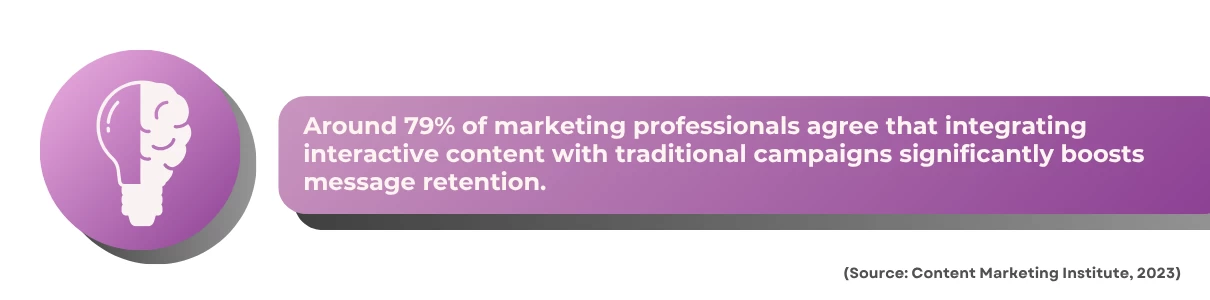
- Cognitive Engagement: Active decision-making (e.g., interacting with a digital menu or a quiz) increases brand recall. Research shows that 79% of marketers agree that combining interactive elements with traditional marketing tactics dramatically improves message retention (Content Marketing Institute, 2023).
- The Endowment Effect: Consumers value experiences more highly when they invest their own effort (e.g., customizing a virtual product). This personal investment increases perceived value, boosting their overall willingness to purchase.
- Dopamine Loops: Gamified interactions (such as spinning a wheel or passing a challenge) trigger immediate reward pathways. This instant gratification builds immediate brand goodwill, encouraging users to progress further down the conversion funnel.
Interactive Promos vs. Static Ads: The Benchmarks
Clear, verifiable industry data backs the performance gap between active and passive advertising:
- Attention Capture
81% of marketers agree that interactive content is significantly more effective at grabbing the attention of passive web visitors than static content (Demand Gen Report, 2022).
- Buyer Engagement
Interactive content experiences generate up to 52.6% more buyer engagement than static, one-way media channels (Cargulia, 2022).
- Customer Retention
Gamified promotions drive up to a 47% increase in long-term customer retention by converting standard transactions into memorable, high-engagement experiences (Tobon et al., 2021).
Actionable Strategies to Maximize ROI
To successfully secure a high financial return, build your interactive campaigns around direct value and friction reduction:
- Replace Forms with Gamified Capture: Traditional multi-field forms feel like administrative work. Replacing them with a 1-minute "brand match" quiz or a gamified giveaway allows you to easily capture high-quality, zero-party contact details while keeping the experience fun.
- Implement Touchscreen Self-Service: In physical retail and F&B, queues represent lost revenue. Self-service kiosks and interactive menus remove order friction. When combined with automated upselling features, these systems regularly drive a 15% to 30% boost in Average Order Value (Harvard Business Review, 2020).
- Optimize via Real-Time Analytics: Unlike static print, digital interactive assets generate immediate data streams. Track click behavior, completion times, and reward claims to instantly identify and remove conversion bottlenecks.
Measuring Success: The Essential KPI Checklist
To prove the financial impact of your campaigns, focus on these four core metrics:
- Interaction Rate: (Total Interactions / Total Impressions) x 100
- Measures: How effectively your visual hook stops the scroll or attracts foot traffic.
- Lead Conversion Rate: (Leads Captured / Total Interactions) x 100
- Measures: If your interactive value proposition is strong enough to convert participants.
- Average Order Value (AOV) Lift: Interactive AOV - Standard AOV
- Measures: The success of built-in upselling on interactive checkout flows.
- Retention Rate Growth: Track repeat purchase frequency over 3, 6, and 12-month windows.
- Measures: The long-term lifetime value (LTV) impact of gamification on customer loyalty.
Elevating Your ROI with PurpleBug
Continuing to run static ads is an expensive way to watch potential customers walk away. By integrating interactive promotions, whether through gamified social media campaigns or in-store self-service kiosks, you transform your marketing from an intrusive interruption into a valuable, engaging customer experience.
At PurpleBug, we design and deploy end-to-end promo automation and gamified marketing solutions tailored to your unique business goals, ensuring higher engagement, increased average order values, and stronger customer loyalty.
Ready to maximize your campaign profitability? Contact us today to discover how we can elevate your digital strategy!
References
Cargulia, C. (2022, November 8)