Innovation & Technology
From Inverted Index to LLM: Why Traditional SEO Is Evolving into GEO
By the end of 2026, traditional search engine query volume is projected to drop by up to 25% (Gartner, 2024). Consumers are rapidly migrating away from typing keywords into empty search boxes to asking conversational AI assistants (Google Gemini, Perplexity, and ChatGPT) to research, compare, and recommend products. If your brand relies entirely on 10 blue organic links, your traffic is at serious risk. To survive, you must bridge the gap between traditional SEO and Generative Engine Optimization (GEO) as AI fundamentally transforms the consumer journey (Gartner, 2024; HubSpot, 2024).
This executive guide breaks down the core structural differences between SEO and GEO, helping your marketing team understand how digital discovery has fundamentally evolved.
Key Takeaways:
- SEO Drives Clicks, GEO Earns Citations: Traditional SEO aims to rank your page for web traffic; GEO ensures your brand is synthesized and cited within AI-generated responses.
- The 25% Search Volume Cliff: Gartner predicts a steep decline in standard search queries as conversational AI assistants become the primary gateway for digital discovery.
- The Citation Economy is Live: Getting cited in AI Overviews and answer engines requires "snippable" content structures, such as tables, statistics, and first-party quotes.
- SEO is the Foundation of GEO: AI models pull citations heavily from first-page search results. You cannot succeed in GEO if your technical SEO baseline is weak.
- Topical Authority Over Keyword Stuffing: Generative engines evaluate context, sentiment, and omnichannel entity trust over raw backlink volume.
SEO vs. GEO: Two Sides of the Discovery Coin
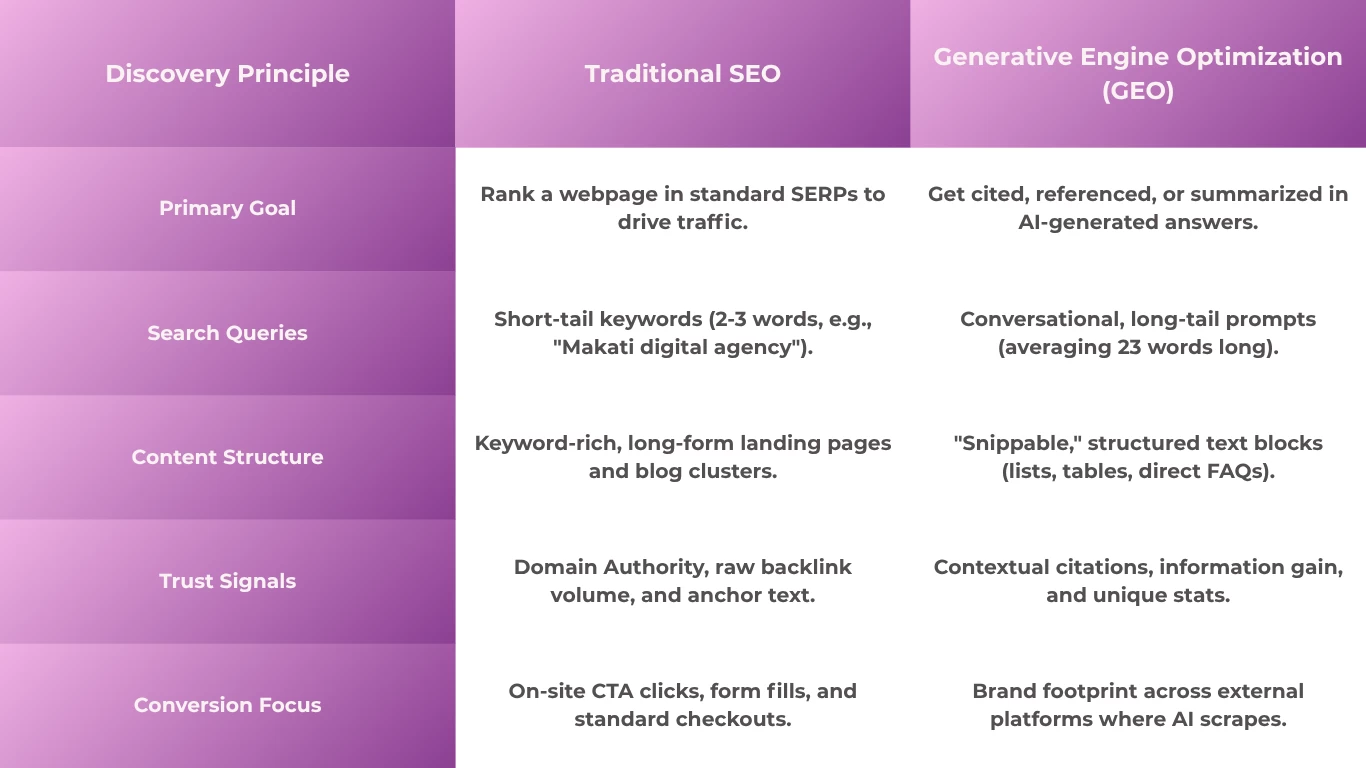
While Search Engine Optimization (SEO) and Generative Engine Optimization (GEO) share a common goal, connecting user intent with relevant business solutions, they function on fundamentally different architectures.
Traditional SEO relies on inverted indexes, crawler bots, and backlink graphs. Success means ranking a webpage on Page 1 of Google's search results so a user clicks your link and self-navigates your site.
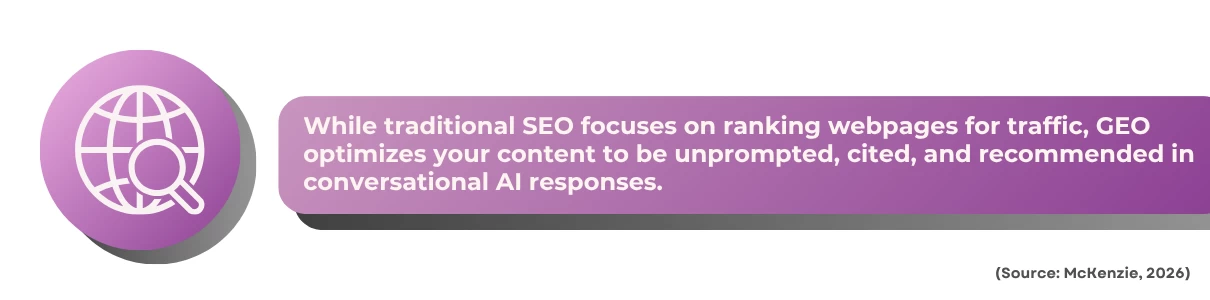
GEO, conversely, is optimized for Retrieval-Augmentation Generation (RAG) pipelines and LLM tokenizers. Its objective is to ensure your brand's unique value is extracted, summarized, and listed as an authoritative, cited source when an AI engine generates a response to a conversational prompt (McKenzie, 2026).
Designing for the Discovery Future
Optimizing for the GEO era does not mean discarding your traditional SEO efforts; it means evolving them. By building structured, authoritative, and deeply contextual content hubs, you increase your organic search visibility while ensuring you become the preferred choice when AI search engines recommend solutions to high-intent buyers.
At PurpleBug, Inc., we help B2B brands and enterprise players navigate this digital shift. Our specialized team audits your technical markup, aligns your omnichannel brand signals, and structures your content so you dominate both traditional SERPs and generative AI answer engines.
Don't let your business fade into the zero-click background. Contact us today to book a comprehensive GEO Assessment!
References
McKenzie, L. (2026, February 11)