News & PR
Anthropic’s Claude Opus 4.8 Signals a Shift in Enterprise AI Cybersecurity
Why AI Security Infrastructure Is Becoming a Core Business Priority
In today’s rapidly evolving artificial intelligence market, competition is no longer centered only on benchmark performance, model size, and reasoning capabilities. As AI adoption expands across industries, businesses are increasingly prioritizing operational reliability, cybersecurity infrastructure, and enterprise governance.
Anthropic recently introduced Claude Opus 4.8, the newest version of its flagship AI model, while also preparing broader deployment of its cybersecurity-focused Mythos systems for enterprise customers. The announcement reflects a wider industry transition in which businesses are investing more heavily in AI systems capable of improving threat detection, automating security operations, and strengthening infrastructure protection.
For organizations integrating AI into software development, workflow automation, cloud infrastructure, and operational systems, access to enterprise-grade AI security tools creates new opportunities to improve efficiency while reducing cybersecurity risks.
That is why AI-powered cybersecurity systems are becoming an increasingly important competitive advantage, helping businesses scale AI adoption while maintaining stronger operational control.
Key Takeaways
- Anthropic introduced Claude Opus 4.8 with improvements focused on reasoning, coding support, and operational reliability for enterprise users. (Reuters, 2026)
- The company announced plans to expand access to its Mythos cybersecurity systems, signaling broader deployment of AI-powered security infrastructure. (Reuters, 2026)
- Enterprise organizations are increasing investment in cybersecurity systems as AI-related operational risks continue growing across industries. (Reuters, 2026)
- Anthropic emphasized stronger safeguards and improved transparency features designed to reduce unsupported outputs during complex tasks. (Anthropic, 2026)
- Advanced AI systems are becoming more capable of supporting software security analysis, vulnerability detection, and automated threat monitoring. (Tom’s Guide, 2026)
- Operational reliability, infrastructure resilience, and governance controls are becoming major competitive priorities across the enterprise AI market. (TradingView, 2026)
Why Is AI Cybersecurity Becoming More Important?
For years, businesses primarily adopted artificial intelligence systems to improve productivity, automate workflows, and support customer engagement. However, as enterprise AI adoption expands, cybersecurity is becoming a much larger part of the decision-making process.
Organizations are now evaluating AI systems based on:
- Operational reliability
- Security capabilities
- Infrastructure flexibility
- Governance standards
- Compliance support
- Threat detection performance
As AI becomes integrated into critical business operations, companies are placing greater emphasis on systems capable of protecting digital infrastructure while improving operational efficiency.
AI-powered cybersecurity systems also help organizations automate repetitive monitoring tasks, allowing security teams to focus on higher-level operational risks and strategic decision-making.
What Makes Claude Opus 4.8 Important?
1. Enterprise AI Security Systems Are Becoming More Advanced
As organizations manage increasingly complex digital environments, the demand for scalable AI-powered security systems continues growing.
This is especially important for:
- Financial institutions
- Software development companies
- Cloud infrastructure providers
- Enterprise operations teams
- Critical infrastructure organizations
Claude Opus 4.8 improves reasoning performance, coding analysis, and long-session consistency, making AI systems more practical for enterprise cybersecurity workflows.
Anthropic also highlighted stronger safeguards and reliability improvements designed to reduce unsupported outputs during complex operational tasks.
These developments are particularly important in cybersecurity environments where accuracy and operational stability directly affect business risk management.
2. AI Competition Is Expanding Beyond Productivity
Anthropic’s latest release highlights how competition across the AI industry is evolving beyond traditional productivity applications.
Companies such as OpenAI, Google, Microsoft, and Anthropic are increasingly competing on:
- Enterprise security integration
- Operational reliability
- Infrastructure resilience
- Governance controls
- Long-term scalability
- Deployment flexibility
As organizations continue scaling AI adoption, operational security may become one of the most important differentiators across the enterprise AI market.
Businesses are increasingly prioritizing systems capable of supporting both productivity and infrastructure protection within the same operational environment.
3. Infrastructure Reliability and Governance Are Becoming More Valuable
Enterprise organizations want AI systems capable of operating across complex infrastructure environments while maintaining strong operational safeguards.
Businesses are increasingly focused on:
- AI access management
- Infrastructure protection
- Data security
- Compliance requirements
- Governance frameworks
- Responsible deployment standards
Anthropic’s focus on enterprise safeguards reflects growing market demand for AI systems that can support long-term operational use while reducing organizational risk exposure.
As enterprise AI systems become more integrated into business operations, infrastructure reliability and governance standards are becoming essential business priorities.
How Could This Impact Businesses?
As AI-powered cybersecurity systems become more advanced, organizations may move faster from limited testing to broader operational deployment.
AI systems can help businesses improve:
- Threat monitoring
- Vulnerability analysis
- Security automation
- Incident response coordination
- Infrastructure visibility
- Compliance management
For startups, AI-powered security systems may reduce operational barriers by lowering the need for large internal security teams.
For larger enterprises, these systems support broader scalability across departments, cloud infrastructure, and distributed operational environments.
AI-assisted security operations may also help businesses reduce operational delays while improving response speed during cyber incidents.
What Challenges Could Follow?
Rising Cybersecurity Risks Across the Industry
While advanced AI systems improve operational efficiency, they may also introduce new cybersecurity concerns.
Security experts continue warning that powerful AI models could potentially be exploited to automate phishing campaigns, identify software vulnerabilities, or accelerate cyberattacks at scale.
As AI capabilities continue advancing, organizations may face increasing pressure to strengthen infrastructure oversight and operational safeguards.
Enterprise Expectations Continue Increasing
Lower operational friction does not reduce business expectations.
Organizations still require:
- Reliable performance
- Strong security protections
- Accurate analytical outputs
- Scalable infrastructure
- Governance transparency
Businesses will continue evaluating AI systems based on how effectively they balance operational performance, cybersecurity reliability, and long-term infrastructure scalability.
Infrastructure Complexity Still Matters
Even as AI systems become more advanced, enterprise infrastructure management remains a major operational challenge.
Organizations deploying AI-powered security systems must still manage:
- Cloud infrastructure costs
- Compliance obligations
- Data protection requirements
- System integration complexity
- Security governance frameworks
Long-term AI scalability will depend not only on model capability, but also on how effectively organizations manage operational infrastructure and cybersecurity oversight.
Where Is the AI Security Market Going Next?
The AI market is entering a more mature phase in which operational reliability and cybersecurity capabilities are becoming just as important as technical performance.
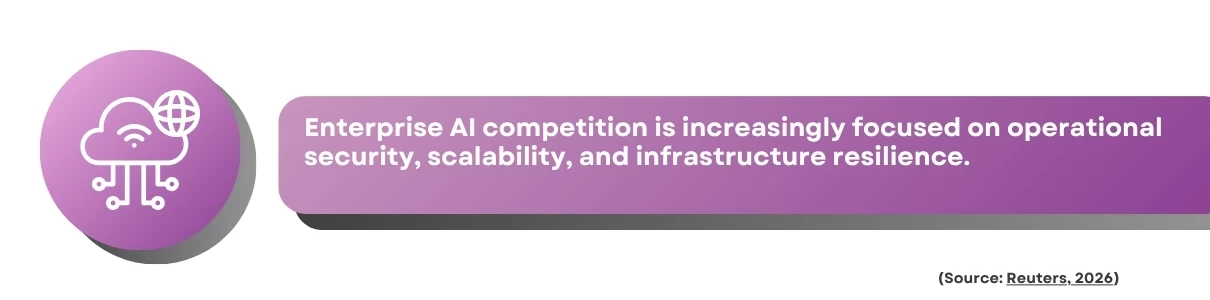
Future competition will likely focus on:
- Stronger cybersecurity systems
- Faster threat response
- Enterprise scalability
- Infrastructure resilience
- Governance transparency
- Safer AI deployment
Anthropic’s latest release reflects this transition.
The next phase of AI competition will likely be defined by which companies make advanced AI systems more secure, scalable, and operationally reliable for enterprise deployment.
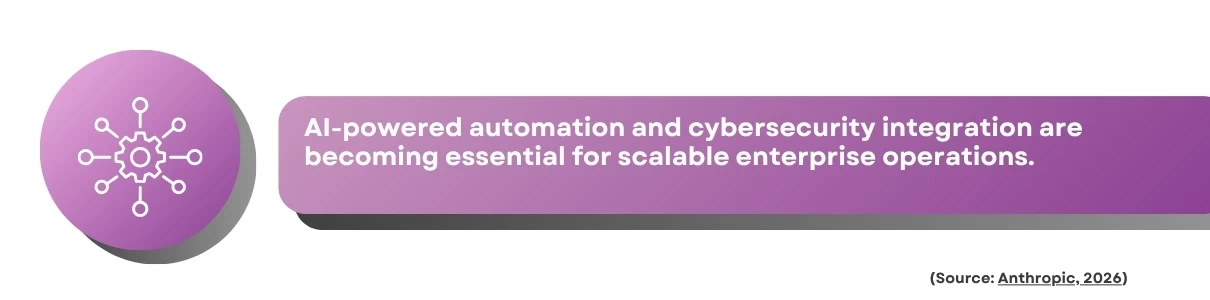
As AI adoption continues expanding across industries, businesses that successfully combine automation, cybersecurity, and infrastructure resilience may gain significant long-term operational advantages.
How PurpleBug’s AI and Applications Technology Helps Businesses Strengthen AI Security Operations
Through integrating AI-powered automation into enterprise operations, PurpleBug’s AI and Applications Technology helps businesses build faster, smarter, and more secure operational systems. By transforming advanced AI models into practical business applications, PurpleBug enables organizations to improve cybersecurity operations, automate repetitive workflows, strengthen infrastructure visibility, and improve operational efficiency across multiple business functions.
This application-driven approach creates stronger enterprise systems by integrating automation, workflow intelligence, cybersecurity operations, and infrastructure management into a more connected operational ecosystem. Through real-time data processing and AI-powered operational support, PurpleBug helps businesses improve threat monitoring, accelerate response times, and strengthen operational resilience across distributed digital environments.
As enterprise AI systems continue becoming more advanced, businesses that strategically apply AI-powered automation will be better positioned to improve productivity, strengthen cybersecurity readiness, and maintain long-term operational competitiveness. PurpleBug’s AI and Applications Technology supports that transition by helping organizations build practical AI systems that are operationally scalable and designed to support long-term digital transformation.
If you are ready to align AI innovation with stronger operational outcomes, explore how PurpleBug’s AI and Applications Technology supports businesses through integrated automation and application-driven solutions designed to create smarter, more scalable, and more secure operational systems.
Have questions or ready to strengthen your AI implementation strategy? Contact the PurpleBug team today and start building smarter and more secure business systems through practical AI applications.