News & PR
DeepSeek’s New AI Model Signals a Shift in Enterprise AI Adoption
Why Lower Costs and Faster Deployment Are Reshaping the AI Market
In today’s fast-moving artificial intelligence market, competition has often centered on model size, reasoning power, and benchmark performance. But as AI adoption grows across industries, businesses are beginning to prioritize something equally important: cost efficiency.
Chinese AI company DeepSeek recently introduced its newest large language model, DeepSeek-V4, alongside major pricing reductions for developers and enterprise users. The launch reflects a broader market shift where affordability and operational scalability are becoming key factors in AI adoption decisions.
For businesses integrating AI into customer support, workflow automation, and internal operations, access to lower-cost AI models creates new opportunities to improve efficiency, reduce costs, and accelerate implementation.
That is why cost-efficient AI is becoming a major business advantage, helping companies scale AI adoption while maintaining stronger operational control.
Key Takeaways:
- DeepSeek introduced its latest AI model designed for enterprise applications and advanced reasoning capabilities. (Reuters, 2026)
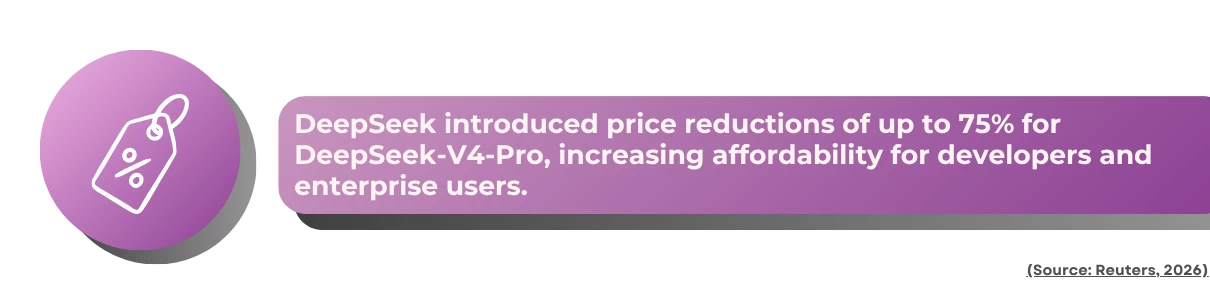
- The company announced pricing reductions of up to 75% for developers using DeepSeek-V4-Pro. (Reuters, 2026)
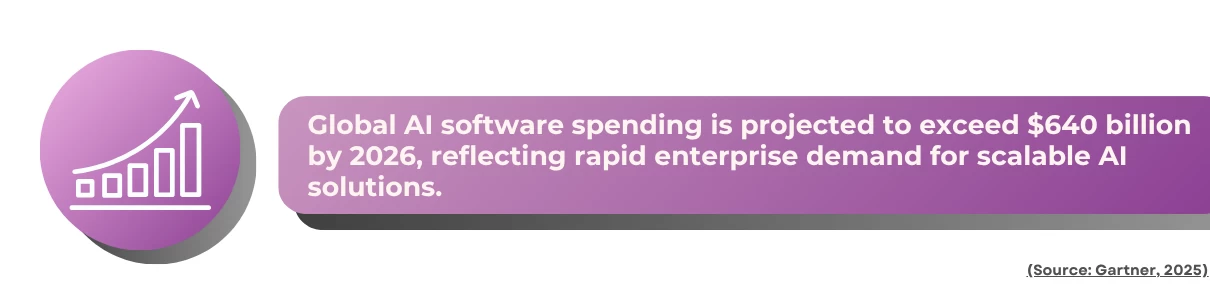
- Global AI software spending is projected to surpass $640 billion by 2026, showing continued enterprise demand. (Gartner, 2025)
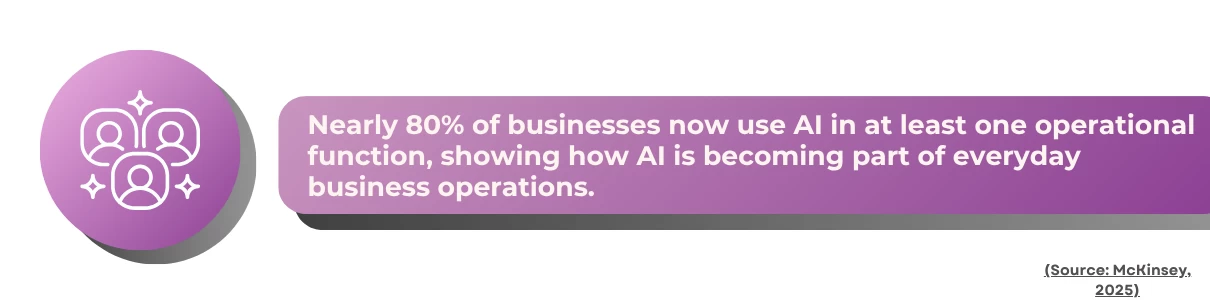
- Nearly 80% of organizations now use AI in at least one business function, reflecting broader operational integration. (McKinsey, 2025)
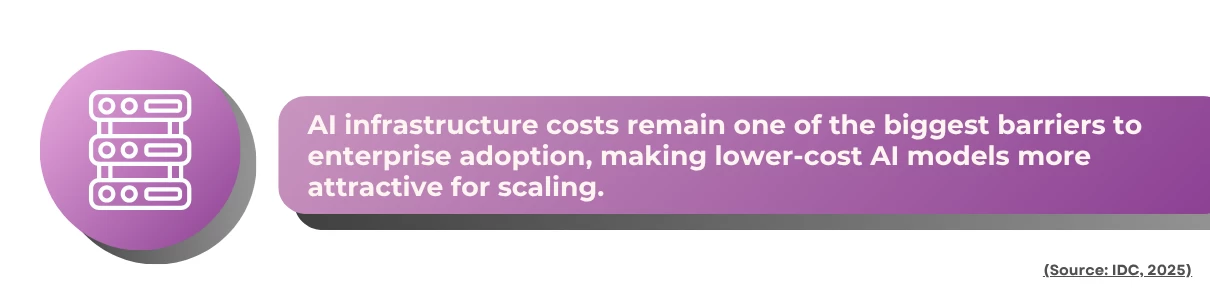
- Infrastructure costs remain one of the biggest barriers to expanding AI implementation for growing businesses. (IDC, 2025)
- Lower-cost and open AI models continue expanding access for startups and enterprise teams. (Stanford AI Index, 2025)
Why Is AI Pricing Becoming More Important?
 For years, businesses selected AI platforms based primarily on performance. Higher-quality models often justified higher costs because access to advanced AI was limited.
But as more providers enter the market, pricing is becoming a bigger part of the decision-making process.
Businesses now evaluate AI platforms based on:
- Cost efficiency
- Scalability
- Deployment speed
- Operational flexibility
As AI becomes part of everyday business operations, long-term infrastructure costs become harder to ignore.
Lower-cost models allow businesses to scale without significantly increasing operating expenses.
What Makes DeepSeek’s New Model Important?
1. Lower Costs Create More Business Opportunities
Deploying AI across business systems can become expensive as usage grows.
 This is especially true for:
- Customer support automation
- Internal productivity tools
- Data analysis systems
- Workflow management
By lowering model costs, DeepSeek makes AI implementation more accessible for businesses that need scalable solutions.
2. AI Competition Is Becoming More Aggressive
DeepSeek’s pricing strategy may influence how other AI providers compete.
 Companies like OpenAI, Anthropic, and Google operate with premium pricing models built around advanced performance.
But as lower-cost models improve, businesses may begin focusing more on return on investment rather than only model capability.
3. Infrastructure Flexibility Is Becoming More Valuable
DeepSeek’s optimization for Huawei Ascend chips highlights the growing importance of hardware flexibility.
Businesses want AI systems that can work across different infrastructure environments while reducing dependency on limited hardware ecosystems.
How Could This Impact Businesses?
As AI models become more affordable, businesses can move faster from testing to full implementation.
 Lower-cost AI makes it easier to build systems for:
- Customer engagement
- Workflow automation
- Internal support systems
- Data-driven decision-making
For startups, this lowers barriers to entry.
For larger organizations, it supports broader scaling across departments.
What Challenges Could Follow?
Rising Cost Pressure Across the Industry
While lower prices benefit buyers, they may create profitability challenges for AI providers.
Building and maintaining advanced AI systems remains expensive.
If pricing continues to drop, companies may face tighter margins while still managing large infrastructure costs.
Performance Expectations Remain High
Lower pricing does not reduce business expectations.
Organizations still need:
- Reliable performance
- Secure systems
- Strong accuracy
- Scalable infrastructure
Businesses will continue to compare costs to performance before making long-term decisions.
Infrastructure Costs Still Matter
Even if model pricing decreases, infrastructure costs remain a challenge.
Where Is the AI Market Going Next?
The AI market is entering a more mature phase in which business outcomes matter as much as technical capabilities.
Future competition will likely focus on:
- Lower operational costs
- Faster deployment
- Better infrastructure flexibility
- Stronger business ROI
DeepSeek’s latest release reflects this transition.
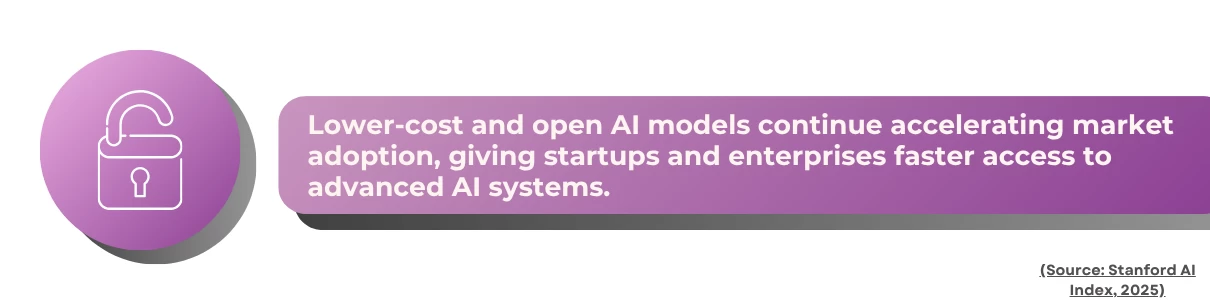 The next phase of AI competition will likely be defined by which companies make advanced AI more practical, scalable, and affordable for business use.
How PurpleBug’s AI and Applications Technology Helps Businesses Scale AI Adoption
Through integrating AI-powered automation into business operations, PurpleBug’s AI and Applications Technology helps businesses build faster, smarter, and more connected workflows. By transforming AI models into practical applications, PurpleBug enables companies to improve customer support systems, automate repetitive tasks, and strengthen operational efficiency across multiple business functions.
This application-driven approach creates stronger business systems by integrating automation, workflow intelligence, and operational processes into a single ecosystem. Through real-time data processing and connected AI applications, PurpleBug helps businesses turn AI investments into measurable efficiency improvements and scalable growth opportunities.
As lower-cost AI models continue making advanced technology more accessible, businesses that apply AI strategically will be better positioned to improve productivity and strengthen long-term competitiveness. PurpleBug’s AI and Applications Technology supports that transition by helping businesses build practical AI systems that are operationally scalable and support long-term digital transformation.
If you are ready to align AI innovation with measurable business outcomes, explore how PurpleBug’s AI and Applications Technology supports businesses through integrated automation and application-driven solutions designed to build smarter and more scalable operational systems.
Have questions or ready to strengthen your AI implementation strategy? Contact the PurpleBug team today and start building smarter business systems through practical AI applications.
References
Gartner. (2025, March 31). Gartner Forecasts Worldwide GenAI Spending to Reach $644 Billion in 2025. https://www.gartner.com/en/newsroom/press-releases/2025-03-31-gartner-forecasts-worldwide-genai-spending-to-reach-644-billion-in-2025?utm
(2025, January). Creating your AI Implementation Blueprint. https://www.delltechnologies.com/asset/en-us/solutions/business-solutions/industry-market/apj-idc-ai-for-enterprise-infobrief-master.pdf?
McKinsey. (2025, March 12). The State of AI: Global survey. McKinsey. https://www.mckinsey.com/capabilities/quantumblack/our-insights/the-state-of-ai-how-organizations-are-rewiring-to-capture-value
Reuters. (2026, April 27). China's DeepSeek slashes prices for new AI model. Reuters. https://www.reuters.com/world/china/chinas-deepseek-slashes-prices-new-ai-model-2026-04-27/
Stanford AI Index. (n.d.). The 2025 AI Index Report. https://hai.stanford.edu/ai-index/2025-ai-index-report