News & PR
Google Accelerates Gemini AI Expansion Across Search, Productivity, and Enterprise Platforms
How Google’s Latest AI Announcements Reflect the Industry’s Shift Toward AI-Integrated Digital Ecosystems
Artificial intelligence is rapidly becoming a central part of how businesses manage workflows, productivity, communication, and digital experiences.
Instead of functioning as standalone tools, AI systems are increasingly being integrated directly into search platforms, workplace applications, collaborative environments, and operational ecosystems.
That transition became more visible during Google I/O 2026, where Google introduced major updates focused on Gemini AI, AI-powered search experiences, developer tools, and expanded Workspace integrations.
The announcements highlight a larger transformation happening across the technology industry as companies continue investing in connected AI ecosystems designed to improve automation, responsiveness, and operational efficiency.
As competition intensifies among Google, Microsoft, OpenAI, and Anthropic, organizations are increasingly evaluating how AI-powered systems may reshape productivity, collaboration, and long-term digital transformation strategies.
Key Takeaways:
- Google introduced major Gemini AI updates during Google I/O 2026, focusing on AI-powered search, multimodal experiences, and productivity tools. (Google Blog, 2026)
- The company emphasized its transition into the “agentic Gemini era,” where AI systems become more proactive, contextual, and integrated across Google products. (Google Blog, 2026)
- Google continues strengthening its position in the AI race as competition intensifies among major technology companies including Microsoft, OpenAI, and Anthropic. (Reuters, 2026)
- AI-powered search experiences and smart assistant technologies are becoming increasingly central to Google’s long-term ecosystem strategy. (The Guardian, 2026)
- Industry competition is increasingly shifting toward integrated AI ecosystems rather than standalone AI tools or chatbot platforms. (Business Insider, 2026)
- AI integration across search, productivity software, mobile platforms, and enterprise systems is expected to continue accelerating throughout 2026. (Google I/O, 2026)
Why Is Google Expanding Gemini Across Its Ecosystem?
For years, artificial intelligence was treated primarily as a supplementary software feature designed to assist with isolated tasks.
Today, technology companies are integrating AI directly into operational systems, workplace environments, and digital workflows.
Google’s latest announcements reflect how AI is becoming increasingly embedded across:
- Search platforms
● Productivity applications
● Mobile ecosystems
● Developer environments
● Workplace collaboration systems
● Enterprise operations
This transition demonstrates how businesses are shifting toward AI-supported ecosystems intended to improve efficiency, responsiveness, and digital coordination across platforms.
Google’s Gemini expansion reflects a broader industry movement where AI is evolving into a foundational operational layer rather than functioning as a separate application.
How AI Search and Productivity Experiences Are Evolving
1. AI Search Is Becoming More Conversational and Contextual
Google continues expanding AI-generated search capabilities designed to improve how users discover and process information online.
The company introduced new AI Overview experiences and multimodal search enhancements intended to provide more conversational and contextual interactions.
According to Google’s official announcements, Gemini-powered systems are designed to support more intelligent and interactive digital experiences.
As AI-generated search summaries become more common, businesses and publishers are increasingly adapting strategies to maintain visibility within evolving search ecosystems.
2. Workplace Productivity Platforms Are Becoming AI-Centered
Google also introduced expanded Gemini integrations across Workspace applications including Gmail, Docs, Meet, and Sheets.
These AI-supported updates focus on:
- Automated summaries
● AI-assisted writing support
● Meeting note generation
● Workflow recommendations
● Collaborative productivity tools
The Guardian reports that Google’s AI strategy increasingly focuses on integrating smart assistant capabilities directly into user workflows and connected digital environments.
This reflects how workplace platforms are evolving toward AI-supported operational ecosystems designed to improve productivity and responsiveness.
3. Competition Across the AI Industry Continues Intensifying
The AI sector remains highly competitive as major technology companies continue investing heavily in AI infrastructure, automation systems, and multimodal experiences.
Google’s latest announcements reinforce how organizations are competing to establish scalable AI ecosystems across both enterprise and consumer environments.
Companies continue increasing investments in:
- AI-powered productivity systems
● Multimodal AI models
● Automation infrastructure
● Intelligent developer tools
● Conversational assistant technologies
As AI adoption accelerates, competition is increasingly centered around ecosystem integration, operational scalability, and long-term user engagement.
What Challenges Continue Emerging Around AI Integration?
Concerns Around Search Visibility and Information Transparency
As AI-generated search summaries become more prominent, publishers and digital organizations continue raising concerns regarding:
- Reduced website traffic
● Search visibility
● Information transparency
● AI-generated misinformation
Media organizations are closely monitoring how AI-generated search experiences may affect audience engagement and digital publishing sustainability.
Businesses integrating AI-supported systems may need stronger transparency and verification frameworks to maintain reliability and user trust.
Balancing Automation With Responsible AI Deployment
While AI systems continue improving productivity and automation, organizations must also evaluate:
- Information accuracy
● Source attribution
● User trust
● Responsible AI governance
● Long-term operational oversight
As AI-generated content becomes more integrated into operational systems and workplace environments, businesses may require stronger governance strategies to support responsible deployment.
Where Is AI Ecosystem Competition Heading Next?
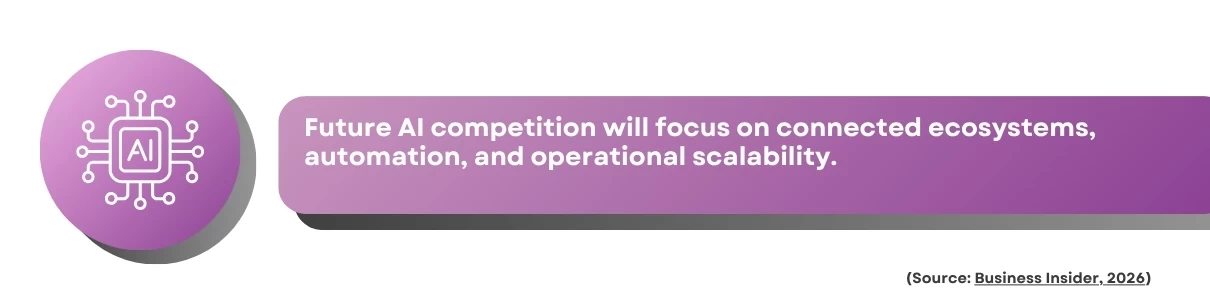
The technology industry is rapidly moving toward connected AI ecosystems where productivity tools, search systems, assistants, and operational platforms work together seamlessly.
Future AI competition will likely focus on:
- AI-supported productivity
● Intelligent workflow automation
● Search intelligence
● Multimodal experiences
● Enterprise scalability
● Context-aware digital systems
Google’s Gemini expansion reflects a broader transformation already reshaping the technology industry.
Businesses are no longer simply experimenting with AI applications.
They are redesigning operational environments around AI-supported systems intended to improve responsiveness, collaboration, efficiency, and long-term scalability.
The next phase of AI transformation will likely be defined not only by technological advancement, but by how effectively organizations integrate AI into operational strategy while maintaining transparency, reliability, and sustainable digital growth.
How PurpleBug’s AI and Applications Technology Helps Businesses Build Smarter AI-Powered Workplaces
As organizations continue integrating AI into workplace systems, productivity platforms, and operational workflows, businesses are increasingly seeking ways to create more connected and scalable digital environments.
PurpleBug’s AI and Applications Technology helps organizations strengthen workplace efficiency through AI-supported applications, workflow automation, and connected operational systems designed to improve collaboration, productivity, and digital coordination.
By combining intelligent automation with integrated workplace technologies, PurpleBug helps businesses streamline repetitive processes, improve operational visibility, and support more responsive day-to-day business operations across teams and departments.
This connected systems approach enables organizations to simplify internal workflows, improve access to operational information, and support scalable digital transformation initiatives through practical AI-powered solutions.
As AI adoption continues influencing workplace operations and business productivity strategies, organizations that successfully align AI integration with long-term operational planning may be better positioned to improve scalability, adaptability, and overall business efficiency.
PurpleBug’s AI and Applications Technology supports that transition by helping businesses modernize workplace systems through connected, scalable, and automation-driven solutions designed to improve operational performance and long-term digital growth.
If your organization is exploring AI-powered workplace transformation, discover how PurpleBug’s AI and Applications Technology can help automate workflows, strengthen operational efficiency, and support smarter digital business ecosystems.
Have questions or ready to strengthen your AI-powered workplace strategy? Contact the PurpleBug team today and discover how connected AI solutions can help support your organization’s long-term operational goals.