News & PR
Meta’s MacroCycle Deal: What Scaling Plastic Recycling Requires
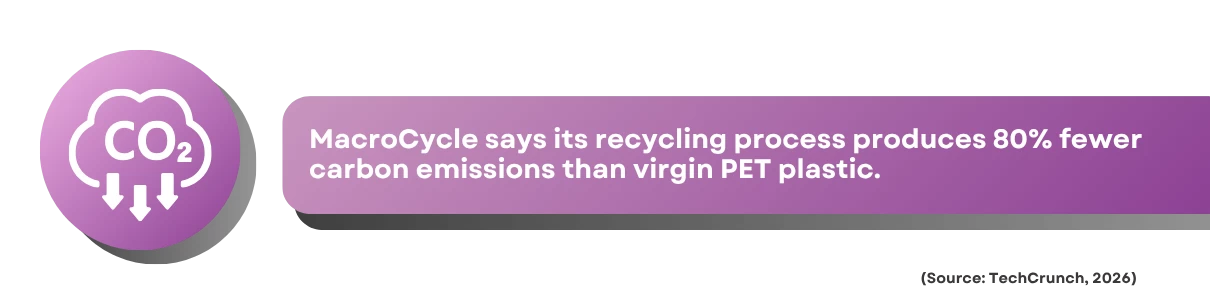
Technology is increasingly being applied to environmental challenges, from resource recovery to more efficient manufacturing. On September 22, 2026, MacroCycle announced an agreement with Meta to support development of its first commercial PET recycling plant in the United States. MacroCycle says its process produces 80% fewer carbon emissions than virgin PET, while its planned demonstration plant is designed to produce 5,000 metric tons of recycled plastic annually (De Chant, 2026).
Key Takeaways
-
Meta’s deal with MacroCycle will help support the construction of the startup’s first commercial recycling plant.
-
MacroCycle uses a solvent-based process to purify PET from different waste streams.
-
Its planned demonstration plant is designed to produce 5,000 metric tons of recycled plastic annually.
-
Scaling emerging technologies requires infrastructure, monitoring, quality controls, and reliable digital systems.
-
Philippine businesses can apply similar technology principles to resource management, compliance, and operational efficiency.
From Plastic Waste to Higher-Quality Materials
Plastic recycling can become challenging when waste contains contaminants or comes from different sources. MacroCycle has developed a process designed to address this challenge by dissolving and purifying polyethylene terephthalate, or PET, from waste streams that include textiles.
According to TechCrunch, the process uses solvents to remove contaminants while preserving the plastic polymers. “MacroCycle describes SolvoGenesis™ as a process that uses proprietary solvents and macrocyclic chemistry to purify and upcycle waste PET.” These polymers can then be linked together to produce recycled material that MacroCycle says is indistinguishable from new plastic (De Chant, 2026).
The approach aligns with broader research into solvent-based recycling. A 2025 review in Nature Chemical Engineering found that solvent-based technologies can produce high-quality plastic resins from different waste sources, while also noting challenges around solvent recovery, process complexity, and continuous scale-up (Xu et al., 2025).
This means developing the technology is only one part of the process. Moving from an innovative concept to commercial production requires engineering, infrastructure, monitoring, and consistent quality controls.
Why the Meta-MacroCycle Deal Matters
The partnership is notable because under the agreement, Meta will purchase environmental attribute certificates associated with recycled PET production. The revenue can help support construction of MacroCycle’s new U.S. plant (De Chant, 2026).
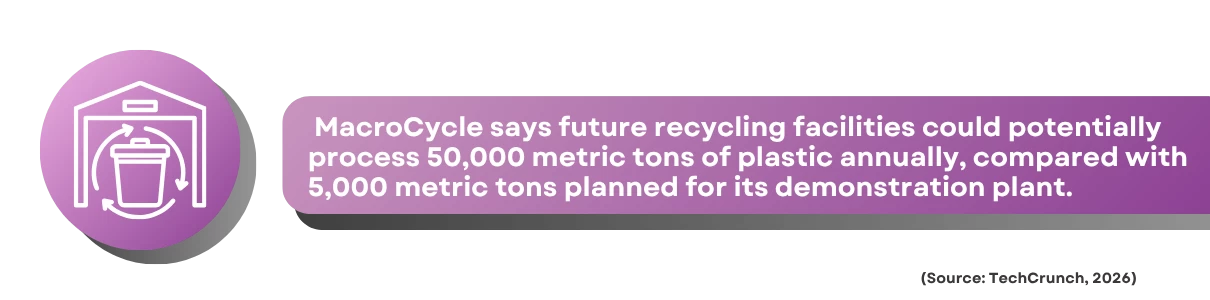
Meta also has an interest in developing a broader market for lower-carbon materials used across its supply chain, including packaging and hardware. MacroCycle says its demonstration plant will produce 5,000 metric tons of recycled plastic per year, while future facilities could reach 50,000 metric tons annually (De Chant, 2026).
The progression illustrates a broader technology-development cycle:
Innovation → Testing → Infrastructure → Deployment → Scaling
For businesses, each stage requires reliable systems to collect information, monitor performance, identify issues, and support decisions.
Technology Needs Quality and Performance Controls
As sustainability technologies become more sophisticated, quality assurance and quality control become increasingly important. Recycling facilities need consistent processes, reliable equipment, accurate measurements, and systems capable of monitoring operations.
The same principle applies to digital technology. Whether a company is implementing software testing services, performance testing, or website performance testing, systems need to perform reliably under actual operating conditions.
Digital systems can also support equipment monitoring, inventory management, compliance reporting, and operational decision-making. These capabilities can form part of an enterprise information system or broader information management system.
For organizations scaling technology-enabled operations, reliable business IT infrastructure becomes equally important. Cloud platforms, connected systems, and monitoring tools can provide the visibility needed to track performance across multiple processes.
What This Means for Philippine Businesses
The MacroCycle development also offers a useful perspective for Philippine companies dealing with sustainability and resource-management requirements. Under Republic Act No. 11898, the Philippines’ Extended Producer Responsibility Act establishes increasing recovery targets for plastic packaging, reaching 60% in 2026 and 80% from 2028 onward (Republic Act No. 11898, 2022).
Recent government reporting also shows why data and monitoring matter. The Philippine Information Agency reported that audited 2024 recovery rates reached 59.98% for rigid plastics and 56.33% for flexible plastics, while the legal target for 2026 is 60% (Philippine Information Agency, 2026).
These requirements create opportunities for businesses to use technology for tracking materials, managing documentation, monitoring suppliers, and organizing compliance activities.
For example, a records management system can help organize compliance documents, while workflow management software can coordinate collection, reporting, approvals, and internal responsibilities. Organizations with distributed operations can also use cloud infrastructure services and cloud monitoring solutions to make operational information more accessible and easier to manage.
From Innovation to Scalable Business Systems
The MacroCycle story highlights an important aspect of modern technology: innovation is not limited to creating digital products. It can also involve applying advanced processes and digital systems to improve physical operations.
Research on plastic recycling similarly emphasizes that commercialization requires a systems-level approach rather than focusing on a single technology in isolation (Xu et al., 2025).
For businesses, this means technology planning should consider the complete operating environment. IT management services, IT infrastructure management services, IT automation solutions, and IT consulting and advisory services can help organizations connect digital systems with operational requirements.
Reliable digital processes also require testing before deployment. Depending on the application, user acceptance testing, usability testing, and broader software testing can help organizations identify issues before systems become part of critical business operations.
How PurpleBug Tech Can Help
Whether technology is being used to track materials, monitor operations, manage compliance data, or automate workflows, the digital infrastructure behind these processes is becoming increasingly important.
PurpleBug Tech helps businesses explore and implement end-to-end technology solutions across development, integration, automation, IT infrastructure, digital systems, AI, and applications. From IT automation solutions and workflow optimization to web and mobile development, infrastructure management, and AI solutions, PurpleBug Tech can help businesses build connected technology around actual operational needs.
The MacroCycle story shows that meaningful innovation requires more than an idea. It requires technology, infrastructure, data, quality controls, and reliable systems to move an innovation from concept to real-world deployment.
Think Innovation. Think PurpleBug Tech.
References
De Chant, T. (2026, September 22). Meta deal will help plastics recycling startup MacroCycle build its first factory. TechCrunch. https://techcrunch.com/2026/09/22/meta-deal-will-help-plastics-recycling-startup-macrocycle-build-its-first-factory/
Philippine Information Agency. (2026, August 21). Marcos admin warns companies of their obligations under Extended Producer Responsibility Act of 2022. Philippine Information Agency
Republic Act No. 11898. (2022, July 23). An act institutionalizing the extended producer responsibility on plastic packaging waste, amending for this purpose Republic Act No. 9003, otherwise known as the “Ecological Solid Waste Management Act of 2000.” Supreme Court E-Library. Supreme Court E-Library
Xu, Z., Sanchez-Rivera, K., Granger, C., Zhou, P., Munguia-Lopez, A. C. del C., Ikegwu, U. M., Avraamidou, S., Zavala, V. M., Van Lehn, R. C., Bar-Ziv, E., De Meester, S., & Huber, G. W. (2025). Solvent-based plastic recycling technologies. Nature Chemical Engineering, 2, 407–423. Nature Chemical Engineering